Preamble
Pursuant to Chapter 143 of the Texas Local Government Code, the Firefighters’ and Police Officers’ Civil Service Commission of the City of Fort Worth, Texas does hereby adopt the following Rules and Regulations for the administration of the Civil Service System for the City of Fort Worth, Texas.
Chapter 1: Organization and General Provisions
ENACTMENT
1.01
The Civil Service System for the City of Fort Worth has been established pursuant to Chapter 143 of the Texas Local Government Code for the purpose of developing and enforcing rules regarding the initial selection of employees as well as for their advancement, benefits, and conditions of employment.
1.02
The rules hereinafter set forth represent a revision of the City of Fort Worth Firefighters’ and Police Officers’ Civil Service Rules and Regulations. These rules completely repeal and replace all prior rules and regulations as have been adopted by the Civil Service Commission. These rules are made in accordance with Chapter 143 of the Texas Local Government Code, hereinafter referred to as "Chapter 143," and specifically pursuant to Section 143.008 of Chapter 143 and legal precedent interpreting the provisions of Chapter 143.
1.03
The scope and construction of the rules hereinafter set forth shall be interpreted and applied within the spirit and intent of Chapter 143. The rules hereinafter set forth are necessary and essential to administer said law. All situations not expressly covered by Chapter 143, Fort Worth City Ordinances, these rules and regulations, the Police and Fire Departments’ rules, standard operating procedures, or general orders shall be resolved in accordance with the City of Fort Worth Personnel Manual of Employee Rules and Regulations or the residual discretionary authority vested in a Department Head. These Rules and Regulations shall apply to all of the employees of the Fire and Police Departments covered under Chapter 143 of the Texas Local Government Code.
CIVIL SERVICE COMMISSION
1.04
The City Manager shall appoint and the City Council shall confirm the appointment of the three members of the Civil Service Commission ("Commission"). In January of each year, the members shall elect one member to serve as Chairperson and one to serve as Vice-Chair. In the event of a vacancy in the chairperson position, the remaining two Commissioners shall promptly elect one Commissioner to fill said position.
1.05
Each member of the Commission holds office for a staggered three year term beginning October 1, and thereafter until a successor is appointed and has qualified. Interim vacancies on the Commission shall be filled for the unexpired term of the member whose position has been vacated in accordance with Section 1.04 of these Rules.
1.06
The Commission has the responsibility to adopt, publish and enforce rules relating to:
- The proper conduct of Commission business;
- The proper conduct of examinations for entry level and promotional eligibility;
- The procedures for appointment and certification;
- The proper conduct of appeals of testing and examination scoring;
- The prescribed cause(s) for the removal or suspension of a civil service employee;
- The procedures for the hearing of appeals concerning indefinite suspensions, suspensions, promotional bypasses or recommended involuntary demotions;
- The procedures for hearings as allowed by Chapter 143; and
- Such other matters reasonably related to the selection, promotion and discipline of civil service employees.
1.07
Regular Business Meetings.
- Meetings of the Civil Service Commission will be scheduled as needed to conduct the business of the Commission.
- Special meetings of the Commission may be called by the Commission Chairperson or the other two Commissioners upon giving advance notice to each member and public notice pursuant to subparagraph (c) below.
- All meetings of the Commission are to be open to the public and the time, date, place and subject matter to be considered at the meeting are to be posted at least seventy-two (72) hours in advance of the meeting in order to give the public and all interested parties proper notice. Such posting shall conform to the requirements of the Texas Open Meetings Act, Article 6252-17, V.A.C.S.
- All agenda items shall be submitted to the Director of Civil Service at least seven (7) days prior to the scheduled meeting date.
- The Secretary of the Commission shall be responsible for posting the public notices prior to each meeting.
- Executive sessions of the Commission shall comply with the Texas Open Meetings Act.
1.08
Two members of the Commission constitute a quorum sufficient to conduct business meetings and hearings.
1.09
Robert's Rules of Order are to be used as a guide by the Commission in its regular business and proceedings. Appeal hearings shall proceed as hereafter set forth in Chapter Thirteen of these Rules and Regulations. The normal order of business at a non-appeal hearing shall generally be:
- call to order;
- approval of minutes of previous meetings;
- communications for consideration;
- consideration of reports;
- unfinished business;
- new business; and
- adjourn.
1.10
The Secretary of the Commission shall be responsible for writing the minutes of each meeting and shall record at least the following:
- the time and place of each meeting of the Commission;
- the names of the Commission members present;
- all official actions of the Commission;
- the official vote by each Commission member;
- upon request, a Commission member's dissent with stated reasons; and
- such other matters as are deemed appropriate for the record.
1.11
The minutes of a meeting are normally to be presented for approval at the next scheduled meeting of the Commission. The minutes, other than matters discussed in executive session, upon approval by the Commission, shall be kept available for public inspection as governed by the Texas Open Records Act. A Commission member may record in the minutes an approval of, or objection from, any act of the Commission together with the Commissioner's reasons.
1.12
After any investigation made by the Commission pursuant to Section 143.009 of Chapter 143, the Commission shall issue its ruling in writing and such ruling shall be binding upon both the Department and the employee, subject to any appeal rights under Chapter 143 and these Rules and Regulations.
1.13
All communications or requests to the Civil Service Commission are to be made in writing through the Office of the Director of Civil Service who shall thereafter proceed to present same for consideration by the Commission. A summary of the request, and the action of the Commission regarding same, will be made in the official minutes of the Commission.
1.14
A member of the Civil Service Commission may tender his/her resignation in writing at any time. A Commission member may be removed from office by the City Council for misconduct in office in accordance with the provisions of Section 143.007 of Chapter 143. Upon the occurrence of any of these events, request shall thereafter be made by the Commission or the Director to the City Manager for a replacement of such member.
(Sections 1.15 Through 1.17 Reserved For Expansion.)
DIRECTOR OF CIVIL SERVICE
1.18
The Commission shall appoint a Director of Civil Service who shall perform work incidental to the civil service system as required by the Commission. The Commission shall have the authority to remove and replace the Director at any time.
1.19
The Director of Civil Service or his/her designated representative(s), will also act as Secretary of the Commission and/or as Chief Examiner of Tests and Test Appeals. The Director or his/her designee shall also:
- Be the general manager of civil service activities and be responsible for the direction of the staff and work product related to those activities;
- Coordinate with the Department Heads the administration of a broad personnel program as required by Chapter 143, which may include but is not limited to:
- serving as Secretary to the Commission;
- serving as the Chief Test Examiner for the Commission and supervisor of all examinations, including the preparation, scheduling, scoring and security thereof;
- recruitment and examination of applicants;
- classification of positions;
- salary recommendations;
- benefit administration;
- employee information and counseling;
- in-service training;
- performance appraisal system;
- leaves of absence;
- maintenance and development of personnel standards and programs;
- procedures for the discipline and/or termination of employees;
- such other matters as may be deemed reasonably necessary in regard to the efficient and effective administration of the Civil Service System for the City of Fort Worth.
- The Civil Service Director or his/her designee(s) shall maintain an official roster containing at least the names, job title or code, salary, time and attendance records, ethnicity, hire date, department and other relevant matters of all employees in the Civil Service of the City of Fort Worth as required pursuant to Chapter 143 of the Local Government Code. Such information shall be available upon request, through the City’s Human Resources Information System.
- The Civil Service Director shall maintain general civil service records to include applicant records, recruitment, examination, appeals, correspondences to and from the Commission, historical information, physical and psychological appeals and any other records related to the business of the Commission.
- The Civil Service Director or his/her designees(s) shall also maintain the personnel files of all employees in the Civil Service of the City of Fort Worth, as required by Section 143.089 of Chapter 143. This record will include all personnel actions, personal employment data, benefit information, and education courses or seminars attended and other matters of an employee's employment history as deemed relevant by the Director, the Department Head or as otherwise required by law.
(Sections 1.20 Through 1.22 Reserved For Expansion.)
COMMISSION RECORDS
1.23
All records of the Civil Service Commission shall be deemed public information and shall be governed by the Texas Open Records Act, Article 6252-17a, V.A.C.S. Those portions of an employee's personnel file and employment record that are deemed not normally subject to public disclosure under the Open Records Act and the legal precedent interpreting same are specifically exempted from the provisions of this paragraph.
RULES AND REGULATIONS
1.24
The Rules and Regulations of the Civil Service System currently in effect are only those contained herein. These rules have been approved by the City of Fort Worth Civil Service Commission and shall remain in effect until officially amended, revised or eliminated by the Commission. (Also, see Chapter 15)
- The Civil Service Commission shall set minimum standards for entry level positions in the Police and Fire Departments. Such standards will be in accordance with statutory law. Changes in State certification requirements will become effective on the date when the minimum standard is revised by the Commission to include such changes and will apply to all future applicants. If the change is of such magnitude that it prohibits licensing, the change will apply to all candidates remaining on an eligibility list.
1.25
The Commission will consider input and suggestions for the conduct of Commission business from any person. Such input shall be reduced to writing, filed with the Director and shall include a clear statement as to what action is recommended. The Commission shall promptly receive the input from the Director. The Commission shall then proceed to take appropriate action or consideration of the input.
1.26
Amendment to these rules may be made at any meeting of the Civil Service Commission after proper submission and prior notice as set forth in these Rules. All rules and amendments shall become effective on the date of their approval by the Commission and subsequent compliance with the posting and notice requirements of Section 143.008 of Chapter 143 and of these rules. All rules and amendments shall be printed and made reasonably available for access by all Civil Service employees.
End of Chapter 1
Chapter 2: Definitions
2.01
All terms, words and phrases contained in these rules shall be interpreted in accordance with Chapter 143 and other applicable law. The following specific definitions shall also apply:
- "Firefighter", "Police Officer", "Commission", "Department Head", and "Director" shall be defined as set out in Section 143.003 of Chapter 143, and shall be considered to include both the male and female gender.
- "Chief Executive" means the City Manager of the City of Fort Worth.
- "Civil Service Rule" shall be defined to include a rule, regulation, general order, standard operating procedure or special order applicable to civil service employees, whether from Chapter 143, the City’s Personnel Rules and Regulations, these Rules and Regulations, or the appropriate Department’s rules and regulations, as they may exist from time to time.
- "Date of Commission" means the date a person takes the oath of service of the appropriate department.
- "Adjusted Commission Date" is a commission date that has been adjusted to account for any time not served as a commissioned officer in the department due to a break in service.
- "Day" means calendar day.
- "Military Service Credit" is applicable to a person who has served in the armed forces of the United States of America and has received an honorable discharge.
- “Hiring Process Administrator/Coordinator” is a permanent member of the recruit training staff appointed by the Fire Chief.
End of Chapter 2
Chapter 3: Classification of Firefighters and Police Officers
3.01
The classifications of Police Officers provided by the Commission, under Section 143.021 of Chapter 143 are:
- Police Trainee
- Police Officer
- Police Corporal
- Police Sergeant
- Police Lieutenant
- Police Captain
- Police Deputy Chief
3.02
The classifications of Firefighters provided by the Commission (approved 8/28/2014), under Section 143.021 of Chapter 143 are:
- Fire Trainee
- Firefighter
- Fire Engineer
- Fire Lieutenant
- Fire Captain
- Fire Battalion Chief
3.03
The title and number of all authorized positions in each of the classifications in the Fire and Police Departments shall only be those as prescribed by ordinances enacted by the City Council.
End of Chapter 3
Chapter 4: Minimum Standards for Entry-Level Positions in the Fire Department
All applicants must meet these standards and requirements as of the last date applications are accepted and subsequently throughout the selection process.
4.01
Age:
- At least 18 years of age by the time of entrance examination.
- A person must not have reached thirty six (36) years of age by the date of the entry-level test required of that candidate.
4.02
Education:
- At the time of application, an applicant must meet one of the following minimum educational requirements:
- Be a high school graduate;
- Have passed a general educational development (GED) test indicating high school graduation level; or
- Have 12 semester hours credit from an accredited college or university;
- Must be able to read and write the English language.
4.03
Military Service: (if applicable)
- Must not have been discharged from any military service under less than honorable conditions including:
- under other than honorable conditions;
- bad conduct;
- dishonorable; or
- any other characterization of service indicating bad character.
4.04
Criminal History:
- Cannot have been convicted for any offense above the grade of a Class B misdemeanor.
- Cannot knowingly, intentionally or recklessly have committed a felony offense as an adult, or have received an unadjudicated or deferred adjudication or be on parole for a felony offense as an adult.
- Cannot have committed a violent felony offense or felony sexual assault as a juvenile.
- Cannot have been convicted for a Class B misdemeanor in the past ten years.
- In the event an applicant receives a conviction, probation, or court ordered community supervision for a criminal offense, the date the conviction, probation, or community supervision is imposed will be used to calculate the time period.
- Cannot be on court-ordered community supervision or probation for any misdemeanor offense above the grade of a C misdemeanor.
- No commissions, unadjudicated or deferred adjudication for any misdemeanor above the grade of a C misdemeanor in the past three years, except for marijuana use.
- In the event of a commission of an offense, the date of the commission will be used to calculate the time of disqualification.
- In the event of a finding of an unadjudicated or deferred adjudication for an offense, the date the offense was committed will be used to calculate the time of disqualification.
- Cannot be the subject of any arrest warrant above the grade of C misdemeanor.
- All C misdemeanor warrants must be cleared within fourteen (14) days of notification of existence of the warrants by the Hiring Process Administrator/Coordinator or his/her designee.
- Cannot have formal criminal charges above a C misdemeanor pending, before a District Attorney’s Office or Grand Jury.
4.05
Driving Record:
- Must possess a valid driver’s license and be able to obtain a Texas "B" driver’s license before completion of the Fire Training Academy;
- No DWI or DUID convictions in the last five years;
- No more than five hazardous moving violations in the last two years;
- No more than two at-fault vehicle accidents in the last two years; and
- No license suspensions in the last one years except that a license suspension for any reason other than hazardous driving violations is not considered a minimum standards violation.
4.06
Drugs/Narcotics:
- No unlawful consumption of marijuana or hashish within the last two years, including edible products that contact THC as described in the Texas Health and Safety Code, THC Oil, or CBD Oils.
- No unlawful consumption of paints, gases, or other abusable chemicals within the last five years.
-
No unlawful consumption of any Texas Health and Safety Code Penalty Group 1-4 drugs within five years, except THC products which is addressed in 5.06(a),
prior to the date of application;
Exceptions:
-
Adderall (or an alternate drug normally prescribed for attention deficit disorder)-12 months if not prescribed to applicant.
-
Anabolic Steroids-Two years prior to application.
4. Consumption or delivery, without remuneration, of any medically prescribed drug, to the applicant or another, for purely medicinal purposes, will not be used to disqualify an applicant.
4.07
Physical Standards:
- Each applicant must pass a physical ability assessment, as prescribed by the Fort Worth Fire Department and approved by the Fort Worth Civil Service Commission, demonstrating the applicant is physically capable of performing the essential job functions for the position of firefighter.
4.08
Other Standards:
- Cannot have intentionally or knowingly provided false information related to the selection process.
- Applicant must meet all the requirements for certification as specified by the Commission on Fire Protection Personnel Standards and Education.
- Applicant must meet all the requirements for certification as a Emergency Medical Technician, as specified by the Texas Department of Health.
- All applicants shall be administered a polygraph examination.
4.09
Definitions:
- Consumption means the injection, inhalation, ingestion, or application of a substance to or into a human body.
- Adult is defined as a person 17 years of age or older.
- Juvenile is defined as a person 10 years of age or older and under 17 years of age.
- DWI or DUID commission is based on a preponderance of the evidence that demonstrates the applicant’s driving capacity was sufficiently impaired by the induction of a substance into the body.
- Intentionally is defined as when a person acts intentionally, or with intent, with respect to the nature of his or her conduct or to a result of his or her conduct when it is his or her conscious objective or desire to engage in the conduct or cause the result.
- Knowingly is defined as an act committed when the applicant was aware of the probable outcome.
- Recklessly is defined as an act committed when the applicant was aware of their actions but consciously disregarded a substantial and justifiable risk that the result would occur.
- Deferred adjudication is defined as when a court of competent jurisdiction, after receiving a plea of guilty or nolo contendere, finds in the best interest of society and the defendant to defer further proceeding without entering an adjudication of guilt. Upon successful completion of conditions imposed by the court, the criminal charge is subsequently dismissed and there is no judgment of guilt entered in the matter.
- Unadjudicated means any offense admitted during a sentence hearing and taken into account by a court in another criminal matter pursuant to Section 12.45 of the Texas Penal Code, or an equivalent federal procedure or statute, or any offense which is not formally filed or prosecuted in a state or federal court by virtue of an agreement allowing the accused to participate in any diversionary program which has been recognized or created by either the court or the prosecutor’s office which provides for the non-filing or the Nolle Prosequi of a criminal case upon the condition that a person successfully complete any certain tasks or curriculum.
- Community Supervision is defined as the placement of a defendant by a court under continuum of programs and sanctions, with condition imposed by the court for a specific period of time where criminal proceedings are suspended, deferred, or sentenced is probated or suspended, whole or in part.
- Placed on Probation means has received an unadjudicated or deferred adjudication probation for a criminal offense.
- Conviction is defined as when a person has been adjudged guilty of or has had a judgment of guilty entered in a criminal case that has not been set aside on appeal, regardless of whether:
- the sentence is subsequently probated and the person is discharged from probation;
- the charging instrument is dismissed and the person is released from all penalties and disabilities resulting from the offense;
- the cause has been made the subject of an expunction order; or
- the person is pardoned, unless the pardon is expressly granted for subsequent proof of innocence.
- Commission of a crime means committing an act or failing to act which the person clearly knew or should have known the act or omission` was illegal.
- Hazardous Moving violations are traffic violations as defined by the Texas Transportation Code or Texas Vehicle Law which directly relates to the operation of a motor vehicle in an unsafe manner. The following are considered to be hazardous moving violations:
- Speeding;
- No Seatbelt/Operator;
- Disobeying a Traffic Control Device;
- Violation of Traffic Signal Device;
- Failure Yield Right of Way;
- Improper Turn;
- Improper Passing;
- No Turn Signal;
- Failure to Obey Police Officer;
- Wrong Side of Street;
- One Way Street;
- Exhibition of Acceleration;
- Racing;
- Leaving Scene of Accident;
- Following Too Closely;
- Backing Unsafely;
- Unsafe Movement Right/Left;
- Crossing Median;
- Impeding Traffic;
- Disregard Barricade;
- Failure to Control Speed to Avoid Collision;
- Passing School Bus; or
- Violations Against Pedestrians.
- Unlawful means a violation of State or local law, civil or criminal, at the time of the event and in the jurisdiction it occurred.
Fort Worth Fire Department Physical Ability Assessment
(approved 9/13/2023)
The physical ability assessment utilized by the Fort Worth Fire Department to assess a candidate’s ability to satisfactorily perform the physical essential job functions of a firefighter consists of two parts. The overall assessment is based on a thorough job analysis of the physical tasks performed by firefighters in the City of Fort Worth.
- 1.5 mile walk/run (1.5MRW). The 1.5MRW is a timed event in which candidates run or walk (or a combination of the two) 1.5 miles around a defined track, as determined by the Fire department. This assessment is intended to measure aerobic fitness. Passing time: 13 minutes, 57 seconds – Pass/Fail only. This assessment event was developed by the consulting firm of ARA Human Factors.
- CPET. The CPET is a measure of an individual’s aerobic capacity and shall be utilized to determine that each applicant meets the aerobic capacity standard for firefighters set forth by the National Fire Protection Association.
End of Chapter 4
Chapter 5: Minimum Standards for Entry-Level Positions in the Police Department
All applicants must meet these standards and requirements as of the last date applications are accepted and subsequently throughout the selection process.
5.01 Age and Citizenship:
- Must be between the ages of 21 and 45 years of age by the date of the entry-level test. (approved 6/18/2009)
- Must be a United States Citizen.
5.02 Education:
- At the time of application, an applicant must meet one of the following criteria:
- Be a high school graduate; or
- Have a high school equivalency certificate (GED) and completed at least 12 hours at an accredited institution of higher education with at least a 2.0 cumulative total grade point average on a 4.0 scale; and (approved 6/18/2009)
- Must be able to speak, read and write the English language.
5.03 Military Service (if applicable):
- Has never received a dishonorable discharge.
5.04 Criminal History:
- Cannot have been convicted for any offense above the grade of a Class B misdemeanor;
- Cannot have been convicted for a Class B misdemeanor in the past ten years;
- Cannot have been convicted for any type of family violence;
- Cannot have knowingly, intentionally, or recklessly committed a felony offense as an adult, or have received an unadjudicated or deferred adjudication for a felony offense as an adult;
- Cannot be on court-ordered community supervision or probation for any misdemeanor offense above the grade of a Class C misdemeanor;
- Cannot have any unadjudicated or deferred adjudication for any misdemeanor offense above the grade of a Class C misdemeanor in the past three years, except for marijuana use; which is addressed under 5.06(a);
- In the event of a finding of an unadjudicated or deferred adjudication for an offense, the date the offense was committed will be used to calculate the time disqualification.
- Cannot be the subject of any current arrest warrant above the grade of a Class C misdemeanor;
- All Class C misdemeanor warrants must be cleared within fourteen (14) days of notification of the existence of the warrants;
- Cannot have formal criminal charges above a Class C misdemeanor pending before the District Attorney’s Office or Grand Jury; and
- Cannot be prohibited by any state or federal statute from possessing a firearm;
- If the facts necessary to establish that an affirmative defense to an offense existed at the time of the commission of the offense, the assumption for purposes of application will be that no offense occurred; (approved 6/18/2009)
- In the event that an applicant receives a conviction, probations, or court-ordered community supervision for a criminal offense the date of conviction, probation, or community service is imposed will be used to calculate the time period. (approved 6/18/2009)
- In the event that an applicant admits to the commission of a misdemeanor offense above the grade of a Class C misdemeanor in the past three years, except for marijuana use; which is addressed under 5.06(a), that admission may not be used for immediate disqualification but will be addressed by the oral review board as a possible disqualifier.
5.05 Driving Record:
- Must possess a valid driver’s license (All TCOLE requires);
- Cannot have more than three convictions, pleas of guilty, or pleas of nolo contendere for hazardous moving violations in the last one year; or
- Cannot have more than five convictions, pleas of guilty, or pleas of nolo contendere for hazardous moving violations in the last two years;
- Cannot have pending or unresolved traffic citations from any agency or jurisdiction whose conviction would create a minimum standard violation; (approved 6/18/2009)
- Cannot have more than two at-fault vehicle accidents in the last two years; and
- Cannot have any license suspensions in the last one year.
5.06 Drugs/Narcotics:
The following prohibitions apply whether or not applicant has been charged or convicted for the stated conduct: (approved 6/18/2009)
- No unlawful consumption of marijuana within the last two years, including edible products that contain THC as described in the Texas Health and Safety Code, THC Oil, or CBD Oils.
- No unlawful consumption of paint, gases, glues, or other abusable chemicals within the last five years;
- No unlawful consumption of any Texas Health and Safety Code Penalty Group 1-4 drugs within five years, except THC products which is addressed in 5.06(a),
prior to the date of application;
Exceptions:
-
Adderall (or an alternate drug normally prescribed for attention deficit disorder)-12 months if not prescribed to applicant.
-
Anabolic Steroids-Two years prior to application.
- Consumption or delivery, without remuneration, of any medically prescribed drug, to the applicant or another, for purely medicinal purposes, will not be used to disqualify an applicant.
5.07 Physical Standards:
- Must pass a physical ability assessment as prescribed by the Fort Worth Police Department and approved by the Civil Service Commission, showing the applicant is physically capable of performing the essential job functions of police officer.
- Within 180 days before the date of employment, each applicant must be examined by a licensed physician who has been approved by the Commission and be declared in writing as:
- Being physically sound and free from any defects which may adversely affect the performance of duties as defined by the essential job functions appropriate to the type of licenses sought; and
- Showing no trace of drug dependency or illegal drug use after a physical examination, blood test, or other medical test.
5.08 Psychological Standard:
- Within 180 days before the date of employment, each applicant must be examined by a licensed psychologist or psychiatrist and be declared in writing by that professional to be in satisfactory psychological and emotional health for licensing as a peace officer. The examination must be conducted pursuant to professionally recognized standards and methods and must be administered by an experienced professional who is a:
- Licensed psychologist or psychiatrist, appointed by the Commission; or
- Qualified psychologist exempt under licensure by the Psychologist Certification and Licensing Act, Section 22, who is recognized under exceptional circumstances, and appointed by the Commission.
5.09 Other Standards:
- Must be of good moral character; (approved 6/18/2009)
- Cannot have intentionally or knowingly provided false information related to the selection process;
- Must meet all the requirements for licensing as specified by TCLEOSE, except the TCLEOSE section which states: Meet the minimum training standards and pass the commission licensing examination for each license sought;
- Cannot currently have a delinquent student loan(s) unless an agreement in writing has been made with the financial institution to repay the delinquent loan. An applicant will be allowed thirty days following the posting date of the eligibility list in which to provide the documentation;
- Must pass without deception a polygraph examination. The applicant will be considered to have passed the polygraph exam if the examiner concludes that no deception is indicated by the applicant’s answers. If the applicant’s answers are determined to be inconclusive, a second polygraph examination by another examiner will be offered. If the results of the second examination are deemed inconclusive a third examination will be offered by a third examiner. If the results of the third examination are deemed inconclusive, it will be considered a minimum standard violation; and (approved 6/18/2009)
- Must be current in payment of child support unless an agreement, in writing, has been made and filed with the appropriate court of jurisdiction; (approved 6/18/2009)
- When the Civil Service Director authorizes a recruitment and examination in accordance with 6.04(a) of these rules, applicants must hold a current Texas Peace Officer License issued by the Texas Commission on Law Enforcement Officer Standards and Education, have served as a peace officer as defined in the Texas Code of Criminal Procedure, Article 2.12, and have at least two years of work experience in a law enforcement patrol capacity, answering calls for service and enforcing criminal laws. (approved 3/26/08)
- Be competent to discharge the duties of the appointment or employment as a Police Officer, as defined by the essential functions of the job. (approved 1/25/23)
5.10 Definitions:
- Consumption means the injection, inhalation, ingestion, or application of a substance to or into a human body.
- Unlawful means a violation of State or local law, civil or criminal, at the time of the event and in the jurisdiction it occurred.
- Adult is defined as a person 17 years of age or older.
- Juvenile is defined as a person 10 years of age or older and under 17 years of age.
- DWI or DUID commission is based on a preponderance of the evidence that demonstrates the applicant’s driving capacity was sufficiently impaired by the induction of a substance into the body.
- A person acts intentionally, or with intent, with respect to the nature of his or her conduct or to a result of his or her conduct when it is his or her conscious objective or desire to engage in the conduct or cause the result.
- A person acts knowingly, or with knowledge, with respect to the nature of his conduct or to circumstances surrounding his conduct, when he is aware of the nature of his conduct or that the circumstances exist. A person acts knowingly, or with knowledge, with respect to a result of his conduct when he is aware that his conduct is reasonably certain to cause the result. (approved 6/18/2009)
- A person acts recklessly, or is reckless, with respect to circumstances surrounding his conduct or the result of his conduct when he is aware of but consciously disregards a substantial and unjustifiable risk that the circumstances exist or the result will occur. The risk must be of such a nature and degree that its disregard constitutes a gross deviation from the standard of care that an ordinary person would exercise under all the circumstances as viewed from the actor’s standpoint. (approved 6/18/2009)
- Deferred adjudication is defined as when a court of competent jurisdiction, after receiving a plea of guilty or nolo contendere finds in the best interest of society and the defendant to defer further proceedings without entering an adjudication of guilt. Upon successful completion of conditions imposed by the court, the criminal charge is subsequently dismissed and there is no judgment of guilt entered in the matter.
- Unadjudicated means any offense admitted during a sentencing hearing and taken into account by a court in another criminal matter pursuant to Section 12.45 of the Texas Penal Code, or an equivalent federal procedure or statute, or any offense which is not formally filed or prosecuted in a state or federal court by virtue of an agreement allowing the accused to participate in any diversionary program which has been recognized or created by either the court or the prosecutor’s office which provides for the non-filing or the Nolle Prosequi of a criminal case upon the condition that a person successfully complete any certain tasks or curriculum.
- Community supervision means the placement of a defendant by a court under a continuum of programs and sanctions, with conditions imposed by the court for a specific period of time where criminal proceeding are suspended, deferred, or sentence is probated or suspended, whole or in part.
- Probation means the person has received an unadjudicated or deferred adjudication probation for a criminal offense.
- Conviction means the person has been adjudged guilty of or has had a judgment of guilty entered in a criminal case that has not been set aside on appeal, regardless of whether:
- The sentence is subsequently probated and the person is discharged from probation;
- The charging instrument is dismissed and the person is released from all penalties and disabilities resulting from the offense;
- The cause has been made the subject of an expunction order; or
- The person is pardoned, unless the pardon is expressly granted for subsequent proof of innocence.
- Expunction means the legal process by which a person who has been placed under custodial or non-custodial arrest for the commission of either a felony or misdemeanor, has the arrest completely deleted from existence. Once an expunction order is issued by the court, all files and records of the arrest are destroyed. An expunged arrest, conviction, or acquittal does not qualify as a conviction. (approved 6/18/2009)
- Commission of a crime means committing an act or failing to act when the person clearly knew or should have known the act or omission was illegal.
- Hazardous Moving Violations are traffic violations as defined by the Texas Transportation Code or Texas Vehicle Law which directly relates to the operation a motor vehicle in an unsafe manner. The following are considered to be hazardous moving violations (approved 6/18/2009)
- Speeding;
- Speeding School Zone;
- No Seatbelt/Operator;
- Child Restraint Violation;
- Disobeying a Traffic Control Device;
- Violation of Traffic Signal Device;
- Failure Yield Right of Way;
- Improper Turn;
- Improper Passing;
- Improper Lane Change;
- No Turn Signal;
- Failure to Obey Police Officer;
- Driving on Wrong Side of Street;
- One Way Street;
- Exhibition of Acceleration;
- Racing;
- Leaving Scene of Accident;
- Following Too Closely;
- Unsafe Backing;
- Crossing Physical Barrier;
- Disregard Traffic Barrier;
- Coasting;
- Driving on Center Lane;
- Disregard RR Devices/Flagman;
- Unsafe Movement Right/Left;
- Crossing Median;
- Impeding Traffic;
- Failure to Control Speed to Avoid Collision;
- Passing School Bus;
- Cut through drive to avoid TCD;
- DUI Minor;
- Failure to Dim Lights;
- Failure to Stop for School Bus;
- Violations Against Pedestrian.
5.11 Fort Worth Police Department Physical Ability and Work Simulation Assessment:
(approved April 26, 2023)
The physical assessment(s) utilized by the Fort Worth Police Department to assess a candidate’s ability to satisfactorily perform the physical essential job functions for individuals applying for the rank and/or position of entry level officer was developed by the consulting firm of Morris and McDaniel.
The assessment is based on a thorough job analysis of the physical tasks performed for individuals applying for the rank and/or position of entry level officer in the City of Fort Worth.
The assessment shall consist of two separate events.
- Physical Resiliency Assessment (PRA): Each event timed separately.
- 1.5-mile run (1.5MR). The 1.5MR is a timed event in which a candidate runs 1.5 miles around a defined track, as determined by the Police department. This assessment is intended to measure aerobic fitness. Passing time: 17 minutes, 51 seconds or less – Pass/Fail only.
- Push-ups (PU). The PU is a maximum effort, timed event (1 minute). This assessment is intended to measure upper body strength. Passing score: 11 or more in 1 minute – Pass/Fail only.
- Sit-ups (SU). The SU is a maximum effort, timed event (1 minute). This assessment is intended to measure abdominal and hip-flexor strength. Passing score: 22 or more in 1 minute – Pass/Fail only.
- 500-meter row (500mR). The 500mR is a timed event in which a candidate rows 500 meters on a fly-wheel air rower, damper setting of 5, as provided by the Police department. This assessment is intended to measure total body anaerobic fitness. Passing time: 2 minutes, 27 seconds or less – Pass/Fail only.
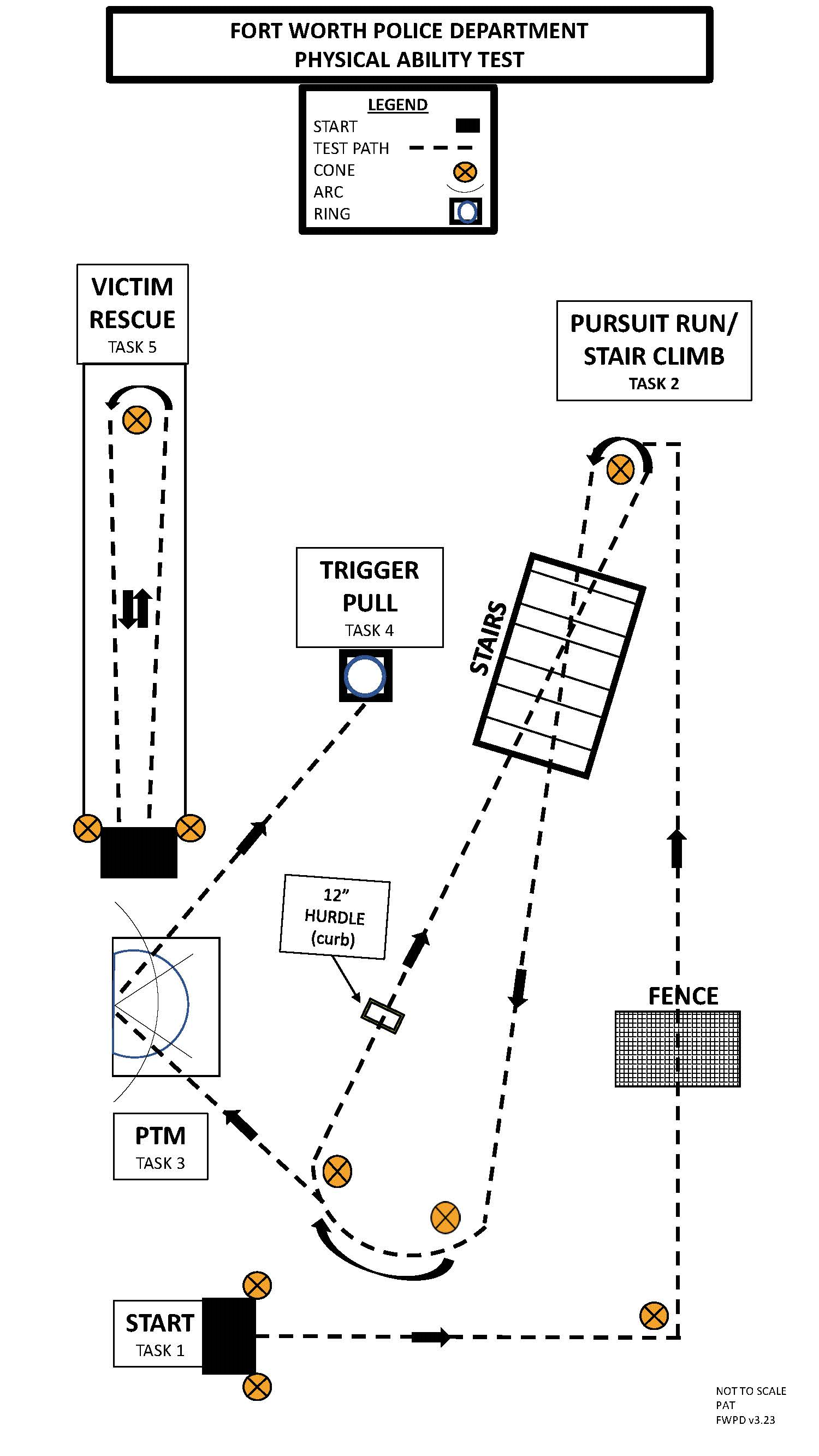
- Physical Ability Test (PAT): The physical ability assessment required by the Fort Worth Police Department is designed to measure the police applicant’s ability to perform the essential functions for individuals applying for the rank and/or position of entry level officer. There are two elements for the PAT:
- Timed Event. Tasks 1-4. Passing time: 2 minutes, 45 seconds or less – Pass/Fail only.
- Untimed Event. Task 5. Pass/Fail only.
Timed Event. The timed event is continuously-timed, and comprised of four tasks completed in this order:
The applicant performs the PAT wearing a weighted vest of approximately 14-17 pounds intended to replicate the standard issue gear of a Fort Worth police officer.
- Sprint and Barrier Surmount. From a kneeling, weapon ready position, the applicant must rise without the assistance of hands/arms, run approximately 60 feet which includes a 90 degree turn and scale a 6-foot chain link fence. Run approximately 40 feet to Task 2.
- Pursuit Run with Curb Hurdle and Stair Climb. Run approximately 300 feet in a “figure 8” pattern with a 12-inch hurdle and stair climb the equivalent of a four-story building. Run approximately 20 feet to Task 3.
- Physical Restraint Task/Power Training Machine (PTM). The PTM replicates the dynamic force, strength, and endurance necessary to restrain a 180-pound individual. Grasping a rope attached to the handle of the machine, apply enough pulling force to lift the weights, and then rotate the machine through four consecutive 180-degree rotations, keeping the weights at all times at the required height. Repeat this task through another four consecutive 180-degree rotations, this time by pushing the handle to lift the weights, rather than pulling. Applicant’s whole foot must cross the entirety of the PTM barrier or the applicant will be instructed to repeat the rotation. Run approximately 30 feet to Task 4.
- Trigger Pull. Holding the weapon at arm’s length and maintaining the hand gun barrel within the target ring pull the trigger 18 times with the dominant hand. Switch to the non-dominant hand and pull the trigger 17 times. Applicant places the hand gun onto the stand and the timed assessment is complete. Timing stops Passing time: 2 minutes, 45 seconds or less- Pass/Fail only.
Untimed Event. The untimed event is comprised of one task and is pass/fail only.
- Victim Rescue (Untimed). Applicant will pick up approximately 88 pounds and walk 30 feet to a designated cone, move around the cone, and walk 30 feet back to the starting point without dropping or setting the weight down.
Applicants applying for the rank and/or position of entry level officer who are competing for entry to the City’s full police trainee academy must pass all required events prior to being considered for placement into the Fort Worth Police Academy.
Applicants applying for the rank and/or position of entry level officer who are competing for entry to the City’s abbreviated academy for TCOLE certified peace officers must pass all required events prior to being considered for placement into the Fort Worth Police LEO Academy.
All Police Officer candidates, whether those graduating from the full police trainee academy or the abbreviated LEO academy are required to pass the PAT prior to academy graduation.
End of Chapter 5
Chapter 6: Application, Examination and Appointment for Entry-Level Positions for Fire and Police Departments
6.01
Any false statement knowingly made by any applicant or made at his/her request or with his/her knowledge in any instrument which may accompany an application or any other document required to be completed during the selection process shall be sufficient cause for the Director to declare the applicant's name to be ineligible for certification.
6.02
Prior notice and posting of upcoming entrance examinations and publication of eligibility lists shall be in accordance with Chapter 143.
6.03
Application forms for entrance examinations shall be designed and prepared by the Director in cooperation with the Department Heads and shall be presented to the Commission for approval prior to use. The applications shall enable the Director to determine whether an applicant meets the minimum qualifications for a beginning position. Applicable minimum qualifications shall be those that comply with the statutory requirements and minimum standards set by the Commission and the appropriate state certification agencies.
6.04
The Director shall cause to be posted in plain view on a bulletin board in the lobby of City Hall and also in the office of the Civil Service Commission the appropriate notices to timely announce upcoming entry level examinations as well as the deadlines for accepting and processing applications. Posting of the examination date shall be made at least twenty-one (21) days prior to the examination. The last day for acceptance of applications shall be no later than fourteen (14) days prior to the examination date.
- Upon the written request of the Police Chief, the Civil Service Director may authorize that the posting of an upcoming entrance examination be limited to only applicants who hold a current Texas Peace Officer license and meet all minimum standards for entry level positions in the Police Department including the minimum standard 5.09(f). (approved 3/26/2008)
- Candidates appointed from an eligibility list created by this examination will be employed as Police Officers with the base pay of a Fort Worth Police Officer. (approved 3/26/2008)
6.05
After the deadline for acceptance of applications, the Director shall review completed applications to determine if each applicant meets the minimum legal and departmental qualifications for the beginning position. In cases where the minimum qualifications are not met, the Director shall notify the applicant that his/her application has been rejected and for what reason(s).
6.06
Military Service Credit. Those persons who make a passing grade on the entrance examination and who desire to have five (5) points added to their examination grades must provide proof of having served in the United States armed forces and received an honorable discharge before the date the eligibility list is posted. The Director shall cause this requirement to also be posted along with all notices for entry level examinations as per 6.04 above.
6.07
Entrance Examination Procedures
- Cancellation: The Director of Civil Service may cancel and thereafter reschedule an entrance examination for sufficient cause.
- I.D. Verification: Only applicants with picture identification will be admitted to the examination. Only qualified applicants who submitted proper applications shall be admitted to the examination.
- Failure to Appear: The applications of persons who fail to appear for the entrance examination shall be voided by the Director of Civil Service.
- Test Administration: The Civil Service Director or his/her designee shall develop appropriate instructions, and standards for the proper administration of an examination.
- Test Monitors: The Director of Civil Service may select a reasonable number of persons employed by the City of Fort Worth to assist in the administration, proctoring and grading of entrance examinations.
- Cheating: Any examinee who uses or attempts to use any unfair or deceitful means to pass an examination shall be informed by the Examiner that the examinee’s action shall be reported to the Commission as well as to the Department Head. The Civil Service Director or his/her designee shall later make a report to the Commission for its determination. If the Commission determines that the examinee used or attempted to use unfair or deceitful means to pass the examination, such examinee shall not be placed on the eligibility list by the Commission.
- Inappropriate Behavior: Any examinee who engages in inappropriate behavior prior to or during an examination shall be warned by the examiner. If the behavior persists or the examinee disrupts the examination process, the examinee may be removed from the examination. A report shall be submitted to the Commission on any such action.
ELIGIBILITY LIST FOR ORIGINAL APPOINTMENT FOR FIRE AND POLICE DEPARTMENTS
6.08
The eligibility list shall be comprised of the final exam scores, beginning with the highest scores descending in order to the lowest scores plus any military service credit.
- An eligibility list for beginning positions in the Police Department shall be in effect for a time period of one year after administration of the last examination, or until the names of all applicants on the list have been referred to the appropriate department, whichever comes first.
- An eligibility list for beginning positions in the Fire Department shall be in effect for a time period of nine months after administration of the last examination, or until the names of all applicants on the list have been referred to the appropriate department, whichever comes first.
6.09
Applicants who have satisfied the prior requirements for documentation entitling them to additional points for military service credit must make at least the minimum passing score (70) before the additional points are added to comprise their total exam score for purposes of ranking on the eligibility list.
6.10 (approved 7/29/2003)
In the event that two or more applicants make identical total final grades as computed under the above section, then the order of their rank on the eligibility list shall be determined in the following manner:
- Residency. If two or more applicants tie on total final scores, then the order of the applicants’ rank on the eligibility list shall be determined on the basis of having been a resident of the City of Fort Worth for a period of one hundred eighty (180) days immediately before the time of application. College students and Active Duty Military shall be considered residents of Fort Worth under the following criteria:
- Applicants who are twenty-three (23) years of age or younger and who are full-time students at an institute of higher learning in another city but whose parent(s) or guardian(s) have been residents of the City of Fort Worth for a period of one hundred eighty (180) immediately before the time of application shall be considered residents.
- Applicants who are on Active Duty status with the United States Military shall be considered residents of Fort Worth if they can present a copy of their deployment orders showing Fort Worth as their city of residence.
- Proof. Any two of the following shall be considered proof of Fort Worth residence.
- A copy of their income tax form for the most recent year listing their legal residence as Fort Worth.
- Proof of ownership of property within Fort Worth.
- Current voter’s registration card listing Fort Worth as their legal residence.
- A current Driver’s License with a Fort Worth address.
- A Fort Worth water bill
- A rental agreement for a residence within the city limits of Fort Worth.
- Random Drawing. If there are still ties, then the order of the applicant’s rank on the eligibility list shall be determined by a number drawn at random by the applicant at the time of examination.
6.11
The name of any eligible person who has been notified to begin processing or is in the process prior to the time he/she is certified to the Chief Executive and declines or is unable or refuses to be processed or violates the departmental processing standards and requirements shall be determined to be ineligible for certification.
(Sections 6.12 Through 6.15 Reserved For Expansion.)
ENTRY-LEVEL HIRING PROCESS FOR FIRE AND POLICE DEPARTMENTS
6.16
The Department will request a referral of the names from the eligibility list to begin processing the applicants. The Civil Service Director or his/her designee will provide a listing of names, along with the applicants’ application forms.
6.17
Applicants will start processing in rank order from the list provided by the Civil Service Director. The department will use the physical ability assessment approved by the Commission and appropriate background investigation techniques, including polygraph examinations, in its processing of applicants
6.18
The Commission through the Director will determine the suitability of each applicant, based on appropriate recommendations and reports from the department as well as review of the information on each candidate.
6.19
Suitability includes all attributes that contribute to a candidate’s overall qualifications to be a Fort Worth Police Officer or Firefighter. Suitability includes, but is not limited to:
- Meeting all legal requirements necessary to become eligible for future licensing by the Commission on Law Enforcement Officers Standards and Education or the Commission on Fire Protection Personnel Standards and Education.
- Meeting minimum standards of the City of Fort Worth, as approved by the Civil Service Commission.
- Being competent to discharge the duties of the appointment or employment as a Police Officer or Firefighter, as defined by the essential functions of each job.
- Complying with all applicant processing procedures as determined by the department and the Civil Service Director. A designation of "unsuitable" will result in a candidate being ineligible for certification to the Chief Executive.
6.20
Recommendations regarding a candidate’s suitability during any phase of processing will be reviewed through the chain of command in the department. All recommendations and changes in recommendations on the issue of suitability will be clearly documented, for future review by the Civil Service Director or the Chief Executive.
6.21
The department will notify the Civil Service Director of the department’s recommendations concerning candidates’ suitability, outlining the reason justifying the designation and providing appropriate documentation.
6.22
Should the Civil Service Director disagree with the recommendation outlined by the department he/she will discuss the issue with the appropriate department head. The Civil Service Director has final authority to determine the suitability or unsuitability of candidates. Unsuitable candidates will be notified by the Director of their status.
6.23
Once the department has completed the processing of the candidates, the department head will request the names of suitable persons from the eligibility list, for the specified number of positions in the training class. The Civil Service Director will certify the specified number of suitable names to the Chief Executive of the City, pursuant to Chapter 143.
6.24
The City Manager will make the final decision on which candidates will be appointed to the entry-level position(s) and will sign the certificate of eligibles which indicates the appointment status of each candidate.
6.25
Appointments and non-appointments will be made in compliance with Section 143.026 of Chapter 143. A letter from the City Manager identifying the good and sufficient reason(s) for not appointing a candidate will be sent to the Civil Service Commission, with a copy to the candidate.
6.26
Candidates appointed by the City Manager will receive a conditional offer of employment.
6.27
Such candidates are then scheduled for medical and, if appropriate, psychological evaluations. Candidates failing either evaluation will be informed of the appeal procedure afforded them by Section 143.022 of Chapter 143. Candidates who appeal must complete their evaluations by the board of three physicians, psychiatrists, or psychologists, as appropriate (Board) within thirty (30) days unless one or more members of the Board of physicians, psychiatrists or psychologists notify the Civil Service Director in writing that they are unable to schedule such evaluation within 30 days. Without such notification from the Board, failure to complete the Board evaluation within thirty (30) days will result in the conditional offer of employment being withdrawn. A candidate appealing to the Board must receive a unanimous decision from the Board that he or she is physically or mentally fit to perform the duties of police officer or fire fighter, as applicable to the appealed decision, in order for the applicant to be appointed to a beginning position. The Board's decision is final.
6.28
A candidate in the appeal process for failure of the physical or psychological examination may be allowed by the Chief Executive to begin the class, with a written letter to the candidate outlining the conditions and the consequences if the candidate fails the Board examination.
(Sections 6.29 through 6.32 Reserved For Expansion.)
REAPPOINTMENT AFTER RESIGNATION FOR POLICE DEPARTMENT
6.33
Former Fort Worth police officers who have voluntarily resigned may be reappointed by the Chief of Police without taking another departmental entrance examination.
6.34
Former Fort Worth police officers desiring reappointment shall submit a request in writing to the Chief of Police and must submit a completed City of Fort Worth employment application.
6.35
Former Fort Worth police officers considered for reappointment will process in accordance with applicable TCLEOSE regulations that address the requirements to commission police officers who have had a break in service.
6.36
Former Fort Worth police officers may at the discretion of the Chief of Police be required to complete a physical ability assessment, background investigation, polygraph examination, department review board, medical examination or psychological examination. The Chief of Police may establish additional conditions for reappointment as deemed appropriate.
6.37
Former Fort Worth police officers shall be reappointed to the Police Department at the discretion of the Chief of Police. The decision by the Chief of Police regarding reappointment shall be final. Former Fort Worth police officers requesting reappointment shall have no appeal or review by the Commission from the final decision of the Chief of Police.
6.38
Former Fort Worth police officers will be reappointed only to the classification of Police Officer as vacancies occur within the Police Department. The Chief of Police shall inform the Civil Service Director when a reappointment is made.
6.39
Former Fort Worth police officers may be required to attend remedial training up to and including the entire basic training as deemed appropriate by the Chief of Police.
6.40
Former Fort Worth police officers reappointed shall serve a probationary period of six months beginning on the date of reappointment. Conditions of the probationary period shall be the same as for police trainees as provided in Chapter 8.02 of these rules and regulations.
6.41
Former Fort Worth police officers reappointed shall be eligible to apply for a promotional examination as provided in Section 143.031 of Chapter 143. Seniority points for addition to a passing examination score shall be calculated on the basis of an adjusted commission date in the department reflecting all time served as a commissioned police officer in the department.
End of Chapter 6
Chapter 7: Training Academy
7.01
All applicants certified and accepted for employment as Firefighter Trainee or Police Trainee shall be required to attend and successfully complete the training academy requirements as determined by their respective department prior to becoming a Firefighter or Police Officer.
7.02
All applicants certified and accepted for employment as Police Officers in accordance with 6.04 shall be required to attend and successfully complete the training academy requirements as determined by the Police Department prior to becoming a commissioned Fort Worth Police Officer. (approved 3/26/08)
End of Chapter 7
Chapter 8: Probationary Period
8.01
All Fire Trainees and Police Trainees shall serve a probationary period of one year and six months (approved 3/26/08) beginning on the date of most recent employment with the department as a Fire Trainee or Police Trainee in the appropriate academy.
8.02
All Firefighters certified by the Commission on Fire Protection Personnel Standards and Education and Police Officers licensed by the Texas Commission on Law Enforcement Officer Standards and Education shall serve a probationary period of one year beginning on the most recent date of commission as a Firefighter or Police Officer with the City of Fort Worth. (approved 3/26/08)
8.03
During the probationary period, Trainees, Police Officers and Firefighters (approved 3/26/2008) are not Chapter 143 Civil Service status employees, but rather are employed "at will" and shall be subject to discharge at the discretion of their Department Head, which discharge shall be final and unappealable to the Commission. This section does not limit any rights to which the employee would otherwise be entitled under law or the City’s Personnel Rules and Regulations.
End of Chapter 8
Chapter 9: Duty Assignment
9.01
The Department Head of the Fire or Police Departments shall have the discretion to make assignments of duty, including transfers, within the classifications in the respective departments. Duty assignments shall not be subject to review by the Commission. Changes in duty assignment shall always be at the discretion of the Department Head.
End of Chapter 9
Chapter 10: Physical and Mental Requirements
10.01
Every member of the Fire Department and Police Department must continually remain in such physical and mental condition as to be capable of rendering safe and efficient service to the City and performance of the duties and essential functions of the appropriate Department.
10.02
All Firefighters and Police Officers shall be required to submit to a psychological or physical examination where there exists some reasonable basis to believe that the individual’s mental or physical fitness for duty is in issue. Determination of the Firefighters’ or Police Officers’ mental or physical fitness for duty shall be subject to Commission review and hearing as provided by the provisions of Section 143.081 of Chapter 143.
End of Chapter 10
Chapter 11: Promotional Procedures
PROMOTIONAL ELIGIBILITY EXAMINATIONS
11.01
At least ninety (90) days prior to the examination, posting of the study materials for the promotional examinations shall be made in accordance with Chapter 143 and these rules.
11.02
At least thirty (30) days in advance of any promotional examination the Director shall cause to be posted in plain view on a bulletin board in the lobby of City Hall, in the lobby of the Police Administration Building or lobby of the Fire Administration Building, and the Office of the Civil Service Commission a notice of such examination. Said notice shall provide the position for which the examination is to be held and the date, time and place thereof. Copies of such notice will be provided to the Department Head for posting in the various stations or sub-stations in the Department.
11.03
Sign-up for a promotional examination must be performed electronically, as outlined in the official examination notice.
11.04
Each applicant for a promotional examination will be required to electronically apply and register verifying that they are interested in sitting for the examination.
- Once an applicant electronically registers for a promotional exam, the Civil Service Director, or designee, will confirm an applicant's eligibility to sit for the promotional examination. An eligibility notice will be sent to applicants confirmed to sit for the promotional exam. An applicant may be required to present a copy of the eligibility notice can be requested at the check in for the exam.
- An employee removed from an appointed classification, at the discretion of the Police Chief, will be returned to the employee's prior tested classification. The time served by the employee in an appointed position shall be considered as a continuation of the time served in the employee's prior tested classification. If the required number of years of service and other eligibility criteria have been met, the employee will be eligible to take a promotional exam to the next higher classification.
11.05
Promotional Examination Administration Procedures
- Cancellation Of Promotional Examination: The Director may cancel and thereafter reschedule a promotional examination for sufficient cause.
- I.D. Verification: At the beginning of the promotional examination, roll call shall be taken from the sign-up list. Any person who has not signed up and does not present proper identification shall not be permitted to take the examination. No applicant shall be admitted to the examination area after the test has started.
- Failure to Appear: A person who fails to appear for a promotional examination shall forfeit their status as an applicant for the examination.
- Cheating: Any examinee who uses or attempts to use any unfair or deceitful means to pass an examination shall be informed by the Examiner that the examinee's action shall be reported to the Commission as well as to the Department Head. The Examiner shall later make a report to the Commission for its determination. If the Commission determines after a hearing that the examinee used or attempted to use unfair or deceitful means to pass the examination, such examinee shall be removed from the eligibility list by the Commission. The Department Head shall also determine if further disciplinary action is warranted.
PROMOTIONAL ELIGIBILITY LIST
11.06
The promotional eligibility list shall consist of a listing of those persons who took the examination with their corresponding passing total final scores, beginning with the highest total final score descending in order to the lowest total final score. An employee’s passing "total final score" shall be computed by combining the number of points received for correct answers plus the number of points allowable for seniority. A maximum limit of ten (10) seniority points may be allowed, one point for each full year of completed service in the Department.
- An employee must receive at least 70 points for correct answers on the examination to have obtained a passing score on the examination.
- Points received by individuals on an examination shall not be finalized until the Commission considers and rules on the appeal of examination results, if any. If no appeals are filed within the appeal period, the points received by each individual on the raw score list shall be used in computing the total final score.
- Seniority points shall be added only to passing scores to obtain a total final score.
- Partial seniority points will not be allowed for service time less than one (1) full year.
- Seniority points for employees in the Fire Department shall be based on the number of full years, up to ten (10), of service time in the Department. Seniority points for employees in the Police Department shall be based on the number of full years, up to ten (10), of service time as a commissioned police officer in the Department.
TIE-BREAKING PROCEDURE
11.07
In the event that two or more persons make identical total final scores, the following procedures will be used to break the tie and to determine placement on the final eligibility list for promotion:
- Highest Test Score. If two or more persons tie on total final scores, then the Commission shall certify the list for those persons in the order according to which person had the highest examination raw score prior to the addition of seniority points and after the Commission determination of appeals, if any.
- Seniority in Rank. If there are still ties, the Commission shall certify the list for those persons in the order according to which person has the most seniority as defined by the date of the most recent promotion or demotion to the (approved 12/16/2008) position immediately below the position for which the examination was given.
- Date of Commission. If there are still ties, the Commission shall certify the list for those persons in the order according to which person has the most seniority with the Department as a commissioned police officer or commissioned firefighter
- Placement On Entry Level Eligibility List. If there are still ties, the Commission shall certify the list for those persons in the order according to how those persons placed on their entry level eligibility list.
POSTING OF EXAMINATION RESULTS
11.08
The raw scores of each examination for promotion shall be posted on a bulletin board located in the lobby of City Hall, in the Office of the Civil Service Commission, and in the lobbies of the Police or Fire Administration Buildings within twenty-four (24) hours after the examination.
11.09
Each promotional eligibility list shall remain in existence for one year after the date on which the written examination is given unless exhausted. At the expiration of the one year period, or after the current list is exhausted, a new promotional examination may be held.
APPEAL OF EXAMINATION RESULTS
11.10
An employee may request the Commission to reconsider the employee’s promotional examination and answers, the grading of same and the source material for the examination by filing a written request with the Director within five (5) business days after the date of the examination. Saturdays, Sundays and legal holidays are excluded in determining the five day period.
11.11
The Director will make appropriate arrangements for the Commission to hear and determine all such requests concerning the same examination at the same time.
11.12
After its determination, the Commission shall certify the appropriate changes, if any, to be made in the scoring of the examination’s raw score points or the computation of the total final score.
11.13
The final eligibility list shall be posted on a bulletin board in the lobby of City Hall, Office of the Civil Service Commission, as well as the administration offices of the Police or Fire Departments, as applicable.
PROMOTIONAL APPOINTMENT
11.14
Promotional appointment shall be made as provided in Section 143.036 of Chapter 143.
- The department head will comply with Section 143.036(f) and (g) of Chapter 143 if the top candidate is not promoted. One of the valid reasons for failure to appoint a promotional candidate is a candidate’s voluntary statement that he/she does not wish to be promoted into the vacancy.
(Sections 11.15 Through 11.17 Reserved For Expansion.)
PROMOTIONAL STATUS
11.18
Occupying the top position on a promotional eligibility list does not create an absolute right to be promoted. It does create an expectancy interest to be promoted subject to:
- the creation of a vacancy in the classified position during the one year existence of the eligibility list;
- a city ordinance which deletes or expresses the intent to delete the particular position upon the occurrence of a vacancy; or
- prior review by the Department Head for determination of a promotional bypass action.
VACANCIES CREATED BY INDEFINITE SUSPENSIONS
11.19
An indefinite suspension is equivalent to dismissal from the department.
11.20
In the case of indefinite suspensions in promotional ranks, the vacancy occurs as of the date of the indefinite suspension. Promotions into the vacancy will follow Chapter 143 requirements.
11.21
If an indefinitely suspended employee’s appeal is sustained (partially or wholly) and the employee is reinstated into a promotional rank, the City will request that the City Council increase the number of authorized positions in that rank in order to comply with the order of the Commission or the hearing examiner; and, request that the City Council decrease the number of authorized positions in that rank and any affected lower ranks in order to continue to operate an efficient organization and operation; and, implement a reduction in force, as authorized in Section 143.085 of Chapter 143.
VACANCIES CREATED BY MILITARY LEAVE OF ABSENCE
11.22 (approved 6/28/2004)
If an employee who is in a promotional rank is on unpaid military leave of absence, a vacancy occurs as of the date the unpaid leave begins. Military leave includes employees’ initial entry into a branch of the service as well as employees who are recalled to active military duty. An employee may request unpaid military leave by making application to the Civil Service Commission. When an employee on military leave must be placed in an unpaid status, this will be construed the same as making application for unpaid military leave with the Civil Service Commission.
11.23
If an employee is receiving full pay from the City while on military leave, whether through vacation, supplemental pay or other paid leave, or through substitutions as authorized in Chapter 143.072(h), no vacancy is created. A vacancy only occurs if an employee is on unpaid military leave of absence.
11.24
For the purpose of these rules, unpaid military leave shall exist anytime an employee does not receive full pay from the City from salary, working agreement, accrued paid leave, supplemental leave benefit or any combination thereof.
11.25
When a vacancy is created due to unpaid military leave of absence, the vacancy shall be filled in accordance with Chapter 143 and the Local Rules of the Civil Service Commission.
11.26
When the employee who is in a promotional rank returns and meets the criteria in Chapter 143.072(d), that employee shall be reinstated to the position that the employee held in the department at the time the leave of absence was granted.
11.27
If an employee who is on military leave of absence is reinstated to a promotional rank, the last person who was promoted to that rank will be returned to their previously held position. If the replaced employee held the position previously held by the employee who was on military leave of absence, the replaced employee shall have preferential right to a subsequent appointment or promotion in accordance with Chapter 143.072(f). Any other employees who are returned to a lower position due to the reinstatement of an employee in a promotional rank will be placed on a reinstatement list for one year in accordance with Chapter 143.085.
(approved 7/6/2010)
11.28
Employees of either the Police or Fire Departments who may miss a promotional examination opportunity due to being on active military service will have two options for taking a promotional exam: (1) the employee may take the examination while on active military duty OR (2) the candidate may take the exam after returning from active military duty. The City may give an examination to the military employee that is not identical to the examination given to other employees. The Human Resources Department will establish procedures for these two methods.
11.29
No employee who takes a promotional exam shall reveal any part or questions from the promotional examination to any employee who will take a make-up exam or an exam at a military location; nor shall any employee preparing to take a make-up promotional exam or an exam at a military location receive from a person any part or questions from a prior promotional examination to gain an unfair personal advantage. Any violation of this section may lead to disciplinary action up to and including termination.
When Testing Employees Who Are Returning to Work from Active Military Duty
(approved 7/6/2010)
11.30
If an employee was unable to take a scheduled promotional exam while on active military duty, the employee may request to be considered for a retroactive promotion based on the employee’s rank order on the next scheduled promotional examination or a make-up exam scheduled according to 11.31. The employee shall only be considered for a retroactive promotion for an eligibility list created for a promotional rank based on the corresponding missed exam. The rank order achieved on the next scheduled promotional examination or make-up exam will be used to determine if the employee would have been promoted from the eligibility list that the service member would have reasonably qualified for had it not been for their military service obligation. If the employee has missed more than one (1) exam, then the employee must take a make-up exam for each exam missed in order to qualify for the corresponding eligibility list. In no circumstance, will a test score apply to more than one (1) eligibility list.
The employee must submit a written request to be considered for a retroactive promotion. This request shall be submitted to the Human Resources Department / Civil Service Testing Division within 30 days of returning to work from the employee’s completed active military service.
11.31
The employee must consult with Human Resources and a reasonable time for test preparation will be determined based on a variety of factors, including but not limited to the length of time the returning employee was absent from work, the level of difficulty of the test itself, the typical time necessary to prepare or study for the test, the duties and responsibilities of the reemployment position and the promotional position, and the nature and responsibilities of the service member while serving in the uniformed service. A make-up promotional exam must be scheduled within 180 days of the employee returning to work. Additional time will be allowed if additional make-up tests are necessary. For each make-up promotional exam requested, the employee must have been able to have met the eligibility requirements in place at the time the original exam was given.
The eligibility list for which a make-up promotional exam was requested by the candidate will be revised to include the employee’s rank order if the employee achieves a passing score.
11.32
If an employee’s final test score(s) from the requested make-up promotional exam(s), after appeals and including tie break procedures, results in a rank order on the corresponding eligibility list that results in the employee being eligible for a promotion, the employee will be considered for a retroactive promotion. All applicable rules or contract provisions shall be followed in making any retroactive promotion. If the retroactive promotion results in displacing the current holder of the position that the employee is eligible for, the current employee and any other later promoted employees will have their promotion dates adjusted. If the adjustments result in an employee being demoted, this employee will be placed on a reinstatement list and will be eligible for promotion in accordance with Local Rule 11.27.
Providing Promotional Exams for Employees Who Are Currently Activated on Military Duty
(approved 7/6/2010)
11.33
Employees who are currently activated on military duty and who cannot return to Fort Worth to take a scheduled promotional examination may request that the exam be given at their military location. The employee must meet all applicable eligibility requirements at that time for the scheduled promotional exam. The absent employee must contact the Human Resources Department / Civil Service Testing Division, by mail or email, at least 30 days before the date of the promotional exam that the employee will not be able to attend. The employee must request that the upcoming promotional exam be administered at the employee’s military location. The Civil Service Testing Division will ensure that all test security precautions are enforced by a pre-identified Test Proctor. No promotional exam will be given without proof of identity of the Test Proctor.
End of Chapter 11
Chapter 12: Scope of Matters Subject to Appeal
12.01
It shall be the duty of the Civil Service departments and also of all employees to use every effort to resolve conflict within the department concerned and to minimize resorting to the appeal processes. No matter what the conflict, management and the employee(s) concerned shall make good faith attempts to peacefully resolve the conflict prior to beginning each subsequent step of the appeal process.
12.02
If an employee is in doubt as to whether or not a situation or issue may be appealed to the Commission, the employee is encouraged to timely file their request for appeal or hearing so as not to inadvertently waive the issue or the filing deadline. The request will then be considered by the Commission who shall respond by informing the employee whether or not the situation or issue is appropriate for consideration by the Commission. If so, then the Director will arrange to have the matter placed on the Commission’s agenda or other such appropriate arrangements.
12.03
Matters Not Subject to Appeal
- Employee dissatisfaction resulting from a transfer or reassignment of duties, in and of itself, shall not constitute grounds for appeal procedures.
- Employee dissatisfaction resulting from a discretionary policy decision or policy matters, in and of itself, shall not constitute grounds for disciplinary appeal procedures.
- An employee who has voluntarily resigned or retired from the Civil Service thereby forfeits all rights to the disciplinary appeal processes, unless the appeal or request for hearing was timely filed prior to retirement or resignation.
- An employee who has voluntarily accepted an agreement in writing which expressly evidences the intent to finally resolve the issue(s) of any form of disciplinary action imposed shall also include a statement to the effect that the employee waives all rights to further proceedings in the disciplinary appeal processes for such specific disciplinary action.
12.04
Matters Subject to Appeal are the following:
- Suspensions;
- Recommended Involuntary Demotions;
- Promotional By-Passes; or
- Any other issues related to Chapter 143 requirements and on which the Commission has authority.
End of Chapter 12
Chapter 13: Suspensions, Recommended Involuntary Demotions, Promotional By-Passes, and Other Appeals
GENERAL PROVISIONS
13.001
Purpose. These rules shall apply to and govern all suspensions, recommended involuntary demotions, promotional bypasses and appeals of the suspensions, recommended involuntary demotions, or promotional bypasses of Fort Worth Civil Service Firefighters and Police Officers pursuant to Chapter 143 of the Texas Local Government Code. The primary purpose of this chapter is to ensure that suspensions, recommended involuntary demotions, promotional bypasses and other appeals are imposed as fairly and equitably as is reasonably possible, with the intention of correcting deficient performance and securing substantial compliance with the working rules and regulations of the Fire and Police Departments.
13.002
All suspensions and recommended involuntary demotions and appeals of suspensions and recommended involuntary demotions concerning civil service employees shall be made in compliance with Chapter 143, these rules and regulations, the City's Personnel Rules and Regulations Manual as well as the rules and regulations of the employee's department.
13.003
Promotional bypasses and appeals thereof shall be made in compliance with Chapter 143.
CAUSES FOR REMOVAL OR SUSPENSION
13.004
The tenure of every civil service employee shall only be during good behavior, and any such employee may be suspended or indefinitely suspended from the civil service for any actions or omission involving one or more of the following grounds:
- The conviction of the employee of a felony or other crime involving moral turpitude;
- Violation of a provision of the Municipal Charter of the City of Fort Worth, Texas;
- Acts of incompetency;
- Neglect of duty;
- Discourtesy by an employee to the public or to a fellow employee while in the line of duty;
- Acts showing a lack of good moral character;
- Ingesting intoxicants while on duty or intoxication while off duty;
- Conduct prejudicial to good order;
- Refusal or neglect to pay just debts;
- Absence without authorized leave;
- Shirking duty, or cowardice at fires; or
- Violation of an applicable Fire or Police Department rule, directive, general or special order.
13.005
The term "cause" shall also mean "employee misconduct" and shall necessarily include any act or omission that violates:
- an applicable provision of Chapter 143, Local Government Code; or
- an applicable rule or regulation duly adopted by the Civil Service Commission of Fort Worth.
13.006
A Department Head may proceed with appropriate suspension arising from any particular factual event(s) or misconduct which would constitute "cause", only when the employee misconduct is related to those matters set forth in Section 143.051 of Chapter 143. (Also See Section 13.004 above).
13.007
For suspension purposes a determination of what constitutes "just cause" is generally made by comparison to what a reasonable person, who is mindful of the habits and customs of their department, who is also mindful of the responsibilities and needs of their department, and who is also mindful of the standards of justice and fair dealing prevalent in the City of Fort Worth, should have done (or should have not done) under similar circumstances.
13.008
Prior to imposing any particular level of suspension, the Department Head may use lesser forms of disciplinary or corrective action. However, nothing herein shall prohibit the Department Head from proceeding directly to the appropriate level of discipline if in the opinion of the Department Head the employee's misconduct warrants the disciplinary action imposed.
(Sections 13.009 Through 13.011 Reserved For Expansion.)
DOCUMENTATION OF DISCIPLINARY ACTION
13.012
An employee in the Civil Service may be suspended by the Department Head by an order in writing submitted in compliance with Chapter 143 stating at least the following:
- the specific Civil Service rule(s) or regulation(s) violated;
- a description of the operative factual events giving rise to the alleged violation of Civil Service Rules;
- the disciplinary action to be imposed;
- the effective dates;
- the rights of the employee to appeal the disciplinary action; and
- such other matters deemed relevant to the action or as required by law.
13.013
The Department Head may not suspend an employee based upon an act that occurred more than 180 days in the past, except as may be provided for in certain criminal investigations as per Sections 143.052(h) and 143.056(h) of Chapter 143.
13.014
The written order of the Department Head imposing a suspension shall comply with Section 143.052 of Chapter 143 and be filed with the Director of the Civil Service Commission within 120 hours after the disciplinary action is imposed. A copy thereof shall also be served on the employee in accordance with Chapter 143.
RECOMMENDED INVOLUNTARY DEMOTION PROCEDURES
13.015
The written order of the Department Head recommending an involuntary demotion shall comply with Section 143.054 (a) and (b) of Chapter 143.
13.016
After the Commission has determined that probable cause does exist for a recommended involuntary demotion and has provided the employee with written notice as per Section 143.054 of Chapter 143, thereafter the action for appeal of the recommended involuntary demotion may be conducted according to the same hearing procedures as set forth herein for suspensions or as expressly provided otherwise in Chapter 143.
PROMOTIONAL BYPASS PROCEDURE
13.017
The written order of the Department Head bypassing a candidate for promotion shall comply with Section 143.036(f) and (g) of Chapter 143.
13.018
After an employee has been bypassed for promotion as per Section 143.036 of Chapter 143, thereafter the promotional bypass appeal shall be conducted according to the hearing procedures as provided in Chapter 143.
ORIGINAL NOTICE OF APPEAL
13.019
The employees notice of appeal must be filed in writing in the Directors office within ten (10) calendar days after receiving the suspension, recommended involuntary demotion or bypass notice of the Department Head. An employee may also withdraw his/her request for an appeal at any time thereafter, which shall operate to terminate the proceedings.
13.020
The employee's notice of appeal and request for hearing shall set forth the employee's basis for appeal in compliance with Section 143.010 of Chapter 143.
FAILURE TO TIMELY FILE AN APPEAL
13.021
Failure on the part of an employee to file an appeal of a suspension, recommended involuntary demotion, or bypass notice with the Office of the Director within the ten (10) day period shall result in no appeal of the matter being considered.
TIME PERIOD AND METHODS FOR FILING DOCUMENTS WITH THE DIRECTORS OFFICE
13.022
Except as otherwise provided by Chapter 143, if a firefighter or police officer wants to appeal to the Commission from an action which an appeal or a review is provided by Chapter 143, the firefighter or police officer need only file a written appeal with the Commission within ten days after the date that the action occurred.
13.023
In computing the period of time allowed by Chapter 143 and these rules, the day of the act or event for which the designated period of time begins to run is not to be included. The last day of the period so computed is to be included, unless it is a Saturday, Sunday, or legal City holiday, in which event the time period runs until 12:00 midnight of the next day which is not a Saturday, Sunday, or legal City holiday.
13.024
For purpose of filing matters with the Civil Service Commission, the Civil Service Directors Office shall be deemed to be open for said purposes and documents may be timely filed up until 12:00 midnight of the last day of the time period.
13.025
Firefighters or police officers who are filing notices of appeal or other matters may do so by facsimile transmission (FAX), by hand delivery or regular or certified mail to the Office of the Civil Service Director. In all cases, it shall be the employees responsibility to maintain the appropriate form of proof of timely fax, service or other delivery to and receipt by the Office of the Civil Service Director.
OPTIONS FOR APPEAL HEARINGS
13.026
If an employee appeals a disciplinary suspension to the Commission, the Commission shall hold a hearing and render a decision in writing within thirty days after the date it receives notice of appeal. The employee and the Commission may agree to extend the thirty (30) day period and postpone the hearing or the deadline for the final ruling.
13.027
At any time after filing the original notice of appeal but before either party has incurred third party hearing examiner expenses, an employee may withdraw the original request for the independent third party hearing examiner and submit the appeal to a hearing before the Commission. The election must be made in writing and filed with the Directors office. However, this election may not be used to manipulate the thirty (30) day hearing deadline imposed on Commission decisions by Chapter 143.
13.028
At any time after filing of the notice of appeal, the parties may mutually agree to withdraw the appeal from an independent third party hearing examiner and submit the appeal to a hearing before the Commission. The mutual agreement must be made in writing and filed with the Director's office.
DIRECTOR TO COORDINATE ALL MATTERS
13.029
The location and accommodations for all hearings and appeals shall be arranged by the Director of Civil Service.
13.030
All subsequent matters raised by either party regarding attendance, scheduling, requests for subpoenas, request for continuances, etc., shall be coordinated through the Director. All such information shall be provided to the Director who shall then provide copies of same to the opposing party or representative and also coordinate the appropriate response or action to be taken. In a hearing coordinated by an outside agency, that agency shall also provide coordination services between the parties and the hearing examiner in conjunction with the Director's office.
EXPENSE AND COSTS
13.031
If appealed to a Hearing Examiner, the Hearing Examiners fees and expenses are shared equally by the employee and the Department.
13.032
Payment of Costs of Witnesses:
- All City employees who are subpoenaed by the City to appear at a disciplinary appeal hearing shall be compensated by the City.
- On-duty employees shall be compensated at their regular rate of pay.
- Off-duty employees shall receive overtime for the actual time spent in the hearing.
- All on-duty and off-duty City employees subpoenaed by the appealing officer/firefighter who are material witnesses to the relevant facts of the matter being appealed shall be compensated by the City in accordance with the procedures described in 13.032 (a).
- All other City employees subpoenaed by the appealing officer/firefighter as character witnesses, or "expert" witnesses, for purposes not directly related to the material facts, or who do not meet the requirements of 13.032 (a) or (b) should seek compensation from the appealing officer/firefighter or the officer/firefighters representative.
- On-duty officers/firefighters subpoenaed for these purposes shall be placed on vacation leave, holiday leave, personal leave, compensatory time off, or if necessary, leave without pay.
13.033
The appropriate amount as well as payment of all costs and expenses may be determined and collected by the Director of Civil Service. An employee may receive an estimate of anticipated costs upon request to the Director.
13.034
When applicable, the State law governing the doctrine of "mitigation of damages" will be applied in computing reimbursements or offset for an award of back pay.
(Sections 13.035 Through 13.037 Reserved For Expansion.)
FAILURE TO ATTEND SCHEDULED HEARING
13.038
The failure of a party to attend a scheduled appeal hearing, or to timely file a request for a continuation of the hearing to a later date, shall not in itself prevent the hearing from proceeding as scheduled nor prevent the Commission from proceeding to take such action as may be appropriate.
EMPLOYEE AND DEPARTMENT REPRESENTATIVES
13.039
The hearing process shall recognize the right of employees as well as the Department to be represented by one or more persons throughout the processing of an appeal. However, only one representative shall be allowed to speak or otherwise present evidence on behalf of either party throughout the questioning of a particular witness.
13.040
Employee and Department representatives shall use their best efforts to help resolve all proceedings smoothly, expediently, and as fairly as possible to all concerned.
13.041
The function of the representatives shall be to articulate the best interests of the employee or the Department represented and to make same pertinent to the issue(s) being considered. Dissatisfaction with a representative shall not constitute grounds for modification of the final ruling.
13.042
All representatives or employees who represent themselves shall become familiar with and follow these rules and regulations at all times during the appeal process.
13.043
Any problems or concerns regarding the manner in which the opposing party or their representative is handling a particular appeal should be brought to the attention of Director of Civil Service. The difficulty will be expeditiously addressed.
(Sections 13.044 Through 13.045 Reserved For Expansion.)
PRE-HEARING PROCESS
13.046
The Texas Rules of Civil Procedure, the Texas Rules of Criminal Procedure, and all other rules of court regarding what is commonly known as "discovery" shall not apply to any Civil Service proceedings. Mediation and arbitration rules and processes do not apply to any Civil Service hearings.
13.047
Parties who request photocopies of documents from the opposing party should be accommodated if such requests are reasonable. Items from departmental policies, rules and regulations manuals may be photocopied. Items such as Accident Review Board recommendations, time and attendance records, duty status forms and other such documents may also be provided so long as they are relevant to the employee and the action under appeal.
13.048
Employees and their representatives may obtain copies of matters contained in any of the employee's personnel files after the employee has signed the appropriate release form(s).
13.049
Before requesting a subpoena duces tecum for the production of documentary material, a party shall first make a request for the materials directly to the other party and provide a reasonable time for a response. If the request is refused or otherwise not produced, then a request may be made to the Commission to issue the subpoena duces tecum. Requests for subpoenas shall be completed at least ten (10) days prior to the scheduled hearing date in order to be timely processed.
13.050
All requests for subpoenas to compel the attendance of a witness shall be coordinated through the Directors Office. Requests for subpoenas shall be completed at least five (5) days prior to the scheduled hearing date in order to be timely processed. The Director may issue subpoenas on behalf of the Commission.
13.051
The parties will exchange exhibit lists at least ten (10) days prior to the beginning of the scheduled hearing and will exchange the identity of all potential witnesses to the other party at least three (3) days prior to the beginning of the scheduled hearing, if not mutually agreed earlier.
13.052
Prior to the hearing, the parties shall make an effort to agree on joint exhibits to be submitted, to stipulate to facts not in dispute and to frame the issues to be decided.
13.053
In the case of an indefinite suspension, whether appealed to the Commission or a hearing examiner the parties will attempt to expedite the scheduling of such hearings. Hearings of indefinite suspensions should take priority over other hearings.
(Sections 13.054 Through 13.059 Reserved For Expansion.)
HEARING PROCEDURES FOR CIVIL SERVICE ISSUES
13.060
At the scheduled time and place, the hearing shall be called to order.
13.061
All parties shall come to the hearing prepared and ready to proceed so as to minimize any disruption of the hearing process. All parties shall bring at least six (6) copies of all documents or exhibits to be considered by the Commission at the hearing.
13.062
All appeal proceedings shall be public hearings.
13.063
A record of the proceedings, capable of clear and accurate reproduction or transcription, shall be made and maintained by the Director.
13.064
After being called to order but prior to the beginning of testimony or evidence, consideration shall be made as to any pre-hearing motions, requests or jurisdictional matters as submitted by either party. The participants shall also seek to obtain as many stipulations as possible as to non-contested or non-material matters. The Commission may "carry" such pre-hearing motions until the hearing is completed and all factual evidence has been presented before making its final ruling thereto.
13.065
Both parties may be allowed to make brief opening statements.
13.066
Unless waived by the participants, the hearing shall then proceed with the reading into the record the statement of charges and specifications as well as factual summary of the operative events as filed with the Commission by the Department Head and which forms the basis of the disciplinary action imposed on the employee.
13.067
The hearing shall then proceed to develop the evidence and testimony as to those contested matters.
13.068
The party with the burden of proof shall go first in the presentation of evidence and testimony. Thereafter, the responding party shall have the opportunity to respond with its own evidence, witnesses or testimony. Thereafter, the party with the burden of proof may come forward with rebuttal evidence or testimony as may be necessary. Presentations by both parties shall be as brief and closely related to the issue(s) as much as is possible. Throughout the proceedings, Commission members may also ask their own questions as needed in order to aid their consideration of the testimony or evidence.
13.069
Witnesses may be sworn and their testimony taken under oath or affirmation. Witnesses are subject to reasonable and relevant cross-examination by the opposing party.
13.070
Upon request by either party, the hearing process may use what is commonly known as "the Rule" concerning oral testimony, meaning that all persons who shall be expected to testify at the hearing, other than the parties and their representatives, shall not be allowed to observe or listen to any of the proceedings except when they are actually testifying as a witness. "The Rule" may be used to ensure one witness testimony is not influenced by anothers testimony. While under "the Rule", potential witnesses shall not discuss any aspect of the appeal or hearing except with the attorneys or the representative involved. Invoking "the Rule" is not mandatory and may be waived in whole or in part by agreement.
13.071
The hearing process shall exercise reasonable control over the questioning of witnesses and the presentation of evidence so as to:
- make an effective ascertainment of the truth;
- keep such presentations relevant to the issues to be determined;
- avoid the needless consumption of time and expense; and
- protect the witnesses and employees from harassment or undue embarrassment.
13.072
The parties and their respective representatives shall cooperate in keeping all presentations as brief and to the point as possible. Long drawn-out sessions shall be discouraged.
13.073
All hearings must remain business-like and focus upon resolution of factual matters. Hearings shall not be a time for accusations, threats, speeches or arguments. The Commission shall have the discretion to adjourn any meeting where the purpose of the hearing is no longer reasonably possible.
13.074
The Commission shall have the discretion to control the length of time of any particular session as well as the amount of time provided for recesses and breaks.
13.075
After the close of the presentation of evidence and testimony, both parties shall be given an opportunity to make closing summations.
13.076
Thereafter, the Commission may adjourn to closed session for deliberation, as prescribed in Section 143.053(d) of Chapter 143. Thereafter, the Commission shall reconvene in open session and shall, upon motion and second, make its decision. Thereafter, a written order containing same shall be prepared and signed by the Commissioners.
(Sections 13.077 Through 13.079 Reserved For Expansion.)
RULES OF EVIDENCE
13.080
Technical rules of evidence shall not apply nor control the conduct of any civil service hearing. The Texas Rules of Court, and the Texas Rules of Evidence shall not apply nor govern any aspect of any civil service proceeding.
13.081
The scope of evidence to be considered at a disciplinary hearing shall be generally limited to matters relevant to the statement of charges as set forth in the Department's written statement, the employee's notice of appeal as well as the employees previous employment record with the Department.
13.082
Either party may offer such relevant evidence as he/she may desire to aid in the determination of material disputed issues.
13.083
It shall be the province of the Commission to ultimately determine:
- the admissibility of any particular evidence or testimony;
- the relevance of any particular evidence or testimony;
- the credibility of any particular evidence or testimony; and
- the materiality or "weight" to be given to any particular evidence or testimony.
13.084
Subject to limited exceptions for compelling reasons shown by a party, the Commission may refuse to hear or consider any testimony or item of evidence if:
- a party has deliberately withheld previously-known and duly requested evidence from the other party until the hearing, and the said evidence should have been previously produced as per these rules; or
- the hearing has been closed.
13.085
The Commission may receive and consider the evidence of witnesses by affidavit and assign it such weight as it deems proper after consideration of objections, if any, made to its admission.
13.086
On-site inspections shall be discouraged and may be conducted only if the evidence to be considered cannot be otherwise presented via stipulations, photographs, videotapes, maps, diagrams, etc.
13.087
All evidence and testimony shall be presented and received into the record while in open session.
(Sections 13.088 Through 13.089 Reserved For Expansion.)
ISSUES TO BE DETERMINED IN DISCIPLINARY APPEALS
13.090
Generally, the determinative issues to be considered and determined by the disciplinary action appeal process shall be:
- Did "cause" exist to support the imposing of some form of disciplinary action as to the employee?;
- Did the employee receive reasonable or appropriate "due process" in the Department's disciplinary process?;
- Was the degree of disciplinary action imposed by the Department "reasonable" under the circumstances?; and
- Has the hearing process developed matters which justify or compel modification of the Department Heads disciplinary action?
13.091
A party is required to establish its factual assertions by a "preponderance of the evidence." A "preponderance of the evidence" means the greater weight and degree of credible testimony or evidence admitted into the record.
13.092
It shall be recognized that prior to imposing any form of discipline, the Department Head may use lesser forms of disciplinary or corrective action. However, the failure to use "progressive discipline" shall not in itself be grounds to overturn or otherwise modify a Department Heads decision to proceed directly to the appropriate level of discipline if the employees misconduct warrants such disciplinary action or termination. Progressive discipline need not always apply and the seriousness of a single offense may negate a previously unblemished record.
13.093
The hearing shall provide the employee every reasonable opportunity to produce objective evidence and testimony to develop:
- that the employee did not commit the misconduct as alleged, i.e., "the facts are not true"; or
- that even if the employee committed the acts as alleged, that such activity does not constitute actionable misconduct; or
- that even if the employee committed actionable misconduct, that the degree of discipline imposed is too harsh or severe, i.e. the disciplinary action imposed was "unreasonable, arbitrary or capricious"; or
- a combination of any of these matters which would justify or compel modification of the Department Head's action.
13.094
An employees mere disagreement or difference in opinion in regard to the department actions or reasoning therefore, without more, shall not constitute grounds to overturn nor modify the disciplinary action.
13.095
If the hearing establishes one valid charge of misconduct supported by evidence sufficient to establish its truth, that charge may be sustained even if other charges in the letter of disciplinary action are not supported by the evidence at the hearing.
(Sections 13.096 Through 13.099 Reserved For Expansion.)
FINDINGS AND ORDERS OF THE COMMISSION
13.100
As a result of the evidence and testimony presented at the hearing, the Commission shall make a just and fair resolution of the matter via a written statement finding the truth of the specific charge(s) against the employee, or a written statement finding that the specific charge(s) against the employee are not true. This issue shall be addressed in all final orders, regardless of the subsequent issues addressed in the same final order.
13.101
In the event that the specific charge(s) of misconduct against the employee are found to be "not true", then the final order and ruling shall be to promptly restore the employee to the employee's proper position or status without penalty.
13.102
In the event that specific charges of misconduct against the employee are found to be "true", then the final order and ruling shall clearly state whether the employee is:
- permanently dismissed from the Fire or Police Department; or
- temporarily suspended from the Department, and shall then set forth the definite time period and conditions of suspension which shall be imposed.
13.103
The final written ruling on all disciplinary appeals shall also include such other matters so as to finally and clearly resolve the issues under consideration, particularly to resolve questions concerning:
- the employee's resulting employment status;
- back pay and other employment benefits;
- mitigation of damages; and
- whether the documents relating to the disciplinary action should be modified or removed from the employees personnel file per Section 143.089(c) of Chapter 143.
13.104
If modifying the disciplinary action of the Department, the final order shall clearly explain in writing the factors and rationale for doing so. If affirming the disciplinary action of the Department, it shall be presumed for same reasons and facts as presented by the Department unless otherwise indicated.
13.105
When necessary, the Commission may consider matters involving questions of applying Chapter 143 to facts or events which may arise during the disciplinary appeal process and which are outside the scope of the Departments statement of charges or the employees notice of appeal. The Commission shall do so only after obtaining an agreement from the parties as to precisely what issue(s) is to be decided.
13.106
The final ruling and order of the Commission may be made by the majority vote of two of the three Commissioners present. If only two Commissioners are present, the final ruling and order must be made in agreement by both Commissioners present.
13.107
A copy of the department's disciplinary action, a copy of the employees request for appeal, the record of the proceedings, a copy of the exhibits submitted together with a copy of the final decision shall be filed in the Commission record. These records may be cited as reference material in subsequent determinations by the Commission.
(Sections 13.108 Through 13.119 Reserved For Expansion.)
APPEALS TO INDEPENDENT THIRD PARTY HEARING EXAMINERS
13.120
Only disciplinary actions concerning an indefinite suspension, a suspension, a promotional bypass or a recommended involuntary demotion are appealable to Hearing Examiners.
13.121
If at all possible, the parties will agree on the selection of the Hearing Examiner.
13.122
At the time that the Director submits the parties agreed date(s) for the hearing, the Director shall also forward to or see that the hearing examiner has the following materials:
- a copy of these Civil Service Commission Rules and Regulations;
- a copy of Chapter 143;
- a copy of the Departments statement of disciplinary charges as filed with the Commission;
- a copy of the applicable City Personnel Rules and Regulations, or Fire Department's Standard Operating Procedures (S.O.P.s), or Police Department's General Orders alleged to have been violated; and
- a copy of the employees notice of appeal as filed with the Commission;
13.123
The Director shall thereafter coordinate with the parties and the agency sponsoring the Hearing Examiner as to all matters regarding scheduling, place of hearing, accommodations, etc.
13.124
The rule-making power and authority of the Civil Service Commission is in no way conferred upon or delegated to any Hearing Examiner, either by implication or otherwise.
13.125
In every disciplinary appeal conducted under Section 143.057 of Chapter 143, the Hearing Examiner shall have the "same duties and powers" as would the Commission, including the right to issue subpoenas to compel the attendance of a witness.
13.126
A disciplinary proceeding conducted by a Hearing Examiner shall be conducted in accordance with Chapter 143.
13.128
After the close of evidence and testimony a Hearing Examiner may deliberate and thereafter enter the ruling either in the same manner as the Commission or as per Section 143.057(g) and (h) of Chapter 143.
13.129
If a situation arises pertaining to the administrative processes of selecting a Hearing Examiner, or meeting notices, or request for rescheduling, recusal, conflict of interest, etc., and the situation is not provided for Chapter 143 or in these Rules and Regulations, then the parties and the Director shall attempt to mutually resolve the situation by agreement. If the matter is not one capable of being reasonably resolved by agreement, then the Director may refer the matter to the administrative processes of the entity sponsoring the Hearing Examiner to resolve the situation within their own processes.
13.130
If a Hearing Examiner has been initially selected but thereafter is objected to or is asked to be recused by a party, both parties may mutually agree to excuse the Hearing Examiner and thereafter request a new list of qualified Hearing Examiners and start the selection process over again. If no such agreement can be reached, then both parties shall prepare a written statement including their request and reasoning therefore which shall be submitted to the Director. The Director shall then transmit same to the agency sponsoring the Hearing Examiner which shall then resolve the dispute according to its own administrative processes. The response shall either excuse the Hearing Examiner and thereafter provide a new list or it shall provide a written statement of reasons why the Hearing Examiner was not excused.
End of Chapter 13
Chapter 14: Administrative Actions
ADMINISTRATIVE INTERPRETATIONS AND APPLICATIONS OF CHAPTER 143
14.01
Whenever an employee or Department Head is in doubt as to whether or not a situation or issue is subject to determination by the Commission, the person is encouraged to promptly file their written request with the Director for Commission determination so as not to inadvertently waive the issue or the filing deadline. The request will then be considered by the Commission and a response will be made stating whether or not the requested action is appropriate for consideration by the Commission. If so, then the Director will arrange to have the matter placed on the Commission's agenda as well as such other appropriate arrangements.
14.02
Whenever an employee or Department Head wishes the Commission to address the manner in which the Civil Service Director has or has not performed a function, the concern should be promptly addressed to the Commission for review and determination.
14.03
A scheduled meeting may be canceled and rescheduled for good cause or by mutual agreement. A timely request for rescheduling shall be coordinated by the Director.
14.04
A scheduled meeting shall be canceled and rescheduled in a timely manner whenever circumstances arise whereby Commission members are unable to convene a quorum at the originally scheduled time.
14.05
The Director is authorized to interpret the Local Rules, providing the interpretation to the requesting party with copies to other interested parties. Disagreement with the Director’s interpretation may be submitted to the Commission for ruling.
End of Chapter 14
Chapter 15: Other Applicable Rules and Regulations
15.01
All other Personnel Rules and Regulations adopted by the City of Fort Worth and which are not in conflict with Chapter 143 or these Rules and Regulations shall also be applicable to Civil Service employees.
End of Chapter 15
Chapter 16: Savings Clause
16.01
The provisions of these Rules and Regulations are declared to be severable. If any rule, section, sentence, clause, phrase or word of these rules shall for any reason be held to be invalid or unconstitutional by a court of proper jurisdiction, such decision shall not affect the validity of the remaining rules, sections, sentences, clauses, phrases and words, but they shall remain in effect, it being the Commission's intent that these rules shall stand notwithstanding the invalidity of any subpart.
End of Chapter 16
Order of Adoption and Recordation
Be it hereby known, that on December 14, 1998, the Civil Service Commission of the City of Fort Worth, Texas, met in open session for the purpose of consideration and adoption of proposed amendments to the City of Fort Worth Firefighters’ and Police Officers’ Civil Service Rules and Regulations. Upon proper motion having been made and seconded, the Commission proceeded to officially adopt the revised Rules and Regulations for Civil Service employees as set forth immediately above.
Therefore, it is the ORDER of this Commission that the Rules and Regulations as set forth immediately above be and are hereby adopted to be the official Rules and Regulations for Fort Worth Civil Service employees.
It is the FURTHER ORDER of this Commission that the Director of Civil Service shall immediately cause these Rules and Regulations to be officially recorded and thereafter promulgated in accordance with Chapter 143 of the Local Government Code.
It is the FURTHER ORDER of this Commission that these Rules and Regulations as adopted shall become fully effective immediately upon their recordation and promulgation in compliance with Chapter 143 of the Local Government Code.
Signed this 14 day of December, 1998.